
Finding the Best (free) Resources for Your 2025 Self-Study Goals
How to set learning objectives and find the best free courses, lectures, and books for self-study in 2025

The internet is an amazing rabbit hole of reading lists, videos, lectures, podcasts and tutorials. I guarantee that anything you want to learn you can do it completely for free. This guide will give you some ideas of where to look to find the very best (free!) resources for your self-study journey.
First up, before we start have you checked out my DIY Teach-Yourself-Anything Notion Template? It will give you the bones to organise all your resources, learning objectives and assignments.
Define Your Learning Objectives
Before you dive into resources, pause to ask: what do I actually want to learn, and why?
Creating clear objectives will give your study structure and keep you motivated when life gets busy. A good learning objective is specific, measurable, and realistic, not just “learn philosophy,” but something like:
“Understand the basics of existentialism by reading three core texts and writing weekly reflections.”
“Be able to analyse short stories for plot, character, and theme using literary theory frameworks.”
Helpful guides for shaping your objectives:
Inspiration from Short & Micro Courses
If you would like inspiration on how to structure your self-study plan and what kinds of resources you might want to look for, free online courses are a fantastic starting point. Many leading universities now offer short, self-paced modules:
FutureLearn – global topics, arts, humanities, STEM
Alison – professional development & certificates
👉 Tip: Search for a university module or course description on your chosen topic. Let’s say we’re curious about Existentialism. Type:
site:.ac.uk existentialism syllabus
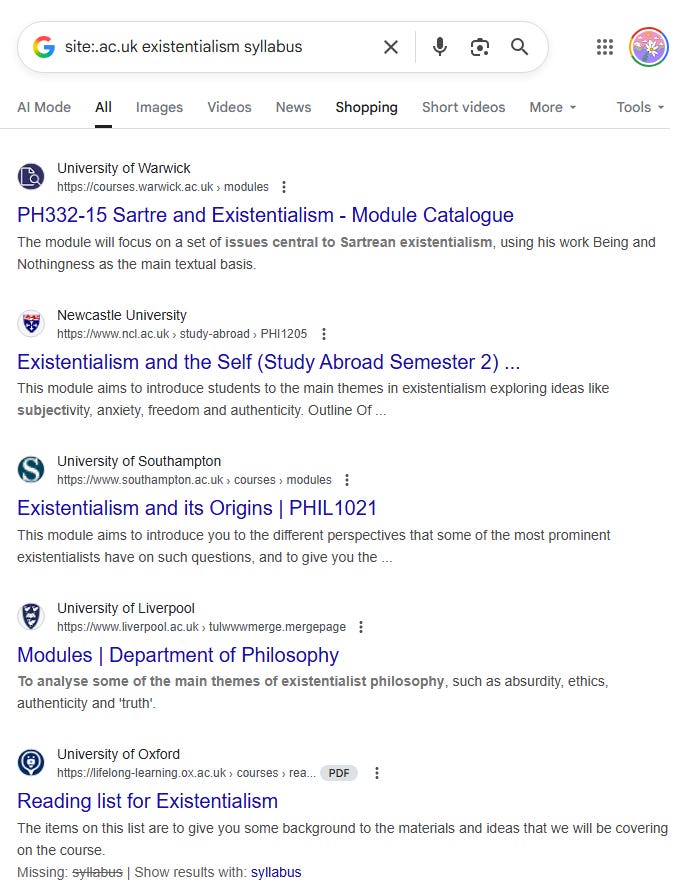
👉 Extra Tip: If you want to find Universities from outside the UK try using “.edu” instead:
site:.edu existentialism syllabus
Lectures, Talks & Tours
Universities and Institutions have shared lots of recordings of their lectures for free online:
There are also lots of simple explainer-channels that explore complex topics in digestible ways. They make a great starting point for dipping your toe in a topic. I like to put a video like this at the start of each unit.
If you’re interested in Art or History, you may want to take “virtual tours” of Galleries and Museums online. Here are some Youtube channels for that kind of thing:
Reading & Research Library
You will of course want to gather reading material. The best part? Much of the world’s greatest literature and research is now freely available.
Books & Primary Texts
Journals & Articles
JSTOR (limited free access)
University Collections
For an overwhelming (but incredible) master list: Josh Bibeau’s Directory of Free Online Resources.
👉 Tip: If you want to find a text quickly, try googling the author name, text name followed by “PDF”.
Don’t Forget “Optional Extras”
A learning resource doesn’t always have to be academic. Mix in some optional extras to your week so you can explore topics in different ways. Here’s some ways I do that:
Find blog posts or Substack newsletters
Watch a related film, documentary or interview
Go on field trips, visit a gallery or museum
Set myself Podcasts to listen to while I’m cleaning or driving
Keep a study journal to write reflections on what I’ve learned
Find online communities/forums where I can discuss what I’ve learned
Design Your DIY Syllabus
Here’s the fun part: pull it all together into your personal learning plan.
Choose one main course (your backbone).
Split this topic into chunks over a series of units (a unit a week, day, month, up to you!)
For each “unit” decide what resources you will watch or read
Set yourself some weekly assignments: readings, reflections, essays, creative projects, or even short presentations to friends.
Put everything into my DIY Teach-Yourself-Anything Notion Template:
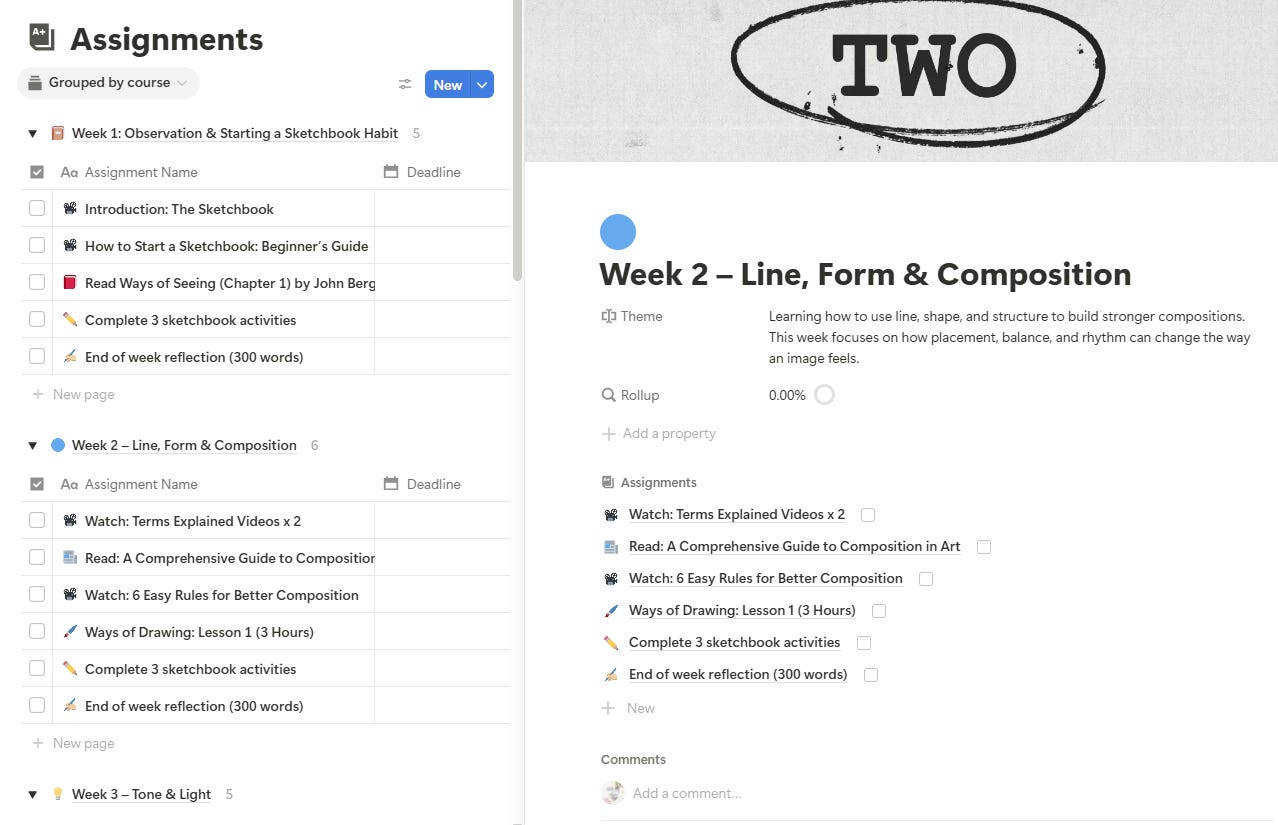
👉 Tip: Use Chat GPT to set yourself some reflection/annotation tasks for when you’re reading. Write the name and author of the text and your learning objectives into Chat GPT, then ask it for some questions about the text or ask for an annotation task. This will help you reflect on what you’re reading in relation to what you set out to learn.
Have fun with it!
Self-study is about curiosity, structure, and joy. So this autumn, instead of doom-scrolling, why not design your own “semester”?
✨ Over to you:
What’s your dream 2025 self-study project? Philosophy? Coding? Art history? Share it in the comments, I’d love to hear what you’re planning.
My substack is free but if you enjoyed this, it would make my day if you could buy me a coffee ☕
We appreciate the shout out, Sarah!
For years, my hobby was "Kim Academy," and I studied all kinds of things. And then Depression set in and I stopped. Your article has hit just as I'm finding my way back to learning again. Thank you!